Willow – Sweater (official video uses MadMapper):
While I have already seen examples of augmented reality used in videos before, I really enjoy how this one by Filip Sterckx exploits the idea further in many different ways, with many different angles, that constantly fool my eyes. At the same time the video is constantly reminding you of the fact that ‘this is an illusion’ with visual queues such as the embedded treadmill or the part where the singers legs are ‘buried’ into the stage to create the illusion that he is standing on the water.

Showing posts with label amazing clip. Show all posts
Showing posts with label amazing clip. Show all posts
Monday, September 17, 2012

Thursday, August 30, 2012
Beyonce at the UN: Behind the Scenes of Epic Projection in the General Assembly Hall [Gallery]
Beyonce at the UN: Behind the Scenes of Epic Projection in the General Assembly Hall [Gallery]:
The new world of projection is big – really big. Planet big. It’s not a dinky projector pointing at a ragged, wrinkled piece of cloth. It’s something that can stand up to one of the world’s great divas.
When you’ve got Beyoncé, and you’ve got the General Assembly Hall of the United Nations in New York City, you’re on a whole new level. Lucas Werthein of SuperUber is kind enough to share with Create Digital Motion the effort that made this all possible. And, we have a photo gallery revealing how all of this came together.

First, he rattles off some of the impressive specs:
The content itself might draw some criticism. The event celebrates the World Health Organization’s World Humanitarian Day, humanitarian efforts and social causes. The imagery, featuring groups like the Red Cross, tends to more traditional aid – this is people in corners of the world being helped by someone else’s hand, rather than helping themselves. But that’s what powerful projection can do: it can make imagery big enough that it invites big thinking — and debate. Even amidst the spectacle here, that kind of powerful immersion can lead people to engage with what images mean, enlightened in a brilliant glare rather than lost in dimmed obscurity. (And, for the record, with an interactive component, the WHO in this case also invited direct commentary on what social action can mean.)
In the end, you see a performance in which neither Beyoncé nor the imagery upstages the other – it’s two powerful performances, not just one.
SuperUber offers more description, which also puts those animations and images in better context.
http://superuber.com


The new world of projection is big – really big. Planet big. It’s not a dinky projector pointing at a ragged, wrinkled piece of cloth. It’s something that can stand up to one of the world’s great divas.
When you’ve got Beyoncé, and you’ve got the General Assembly Hall of the United Nations in New York City, you’re on a whole new level. Lucas Werthein of SuperUber is kind enough to share with Create Digital Motion the effort that made this all possible. And, we have a photo gallery revealing how all of this came together.

First, he rattles off some of the impressive specs:
ProjectionThis is projection mapping, though onto a fairly simple surface. What makes the mapping so effective is the way in which it can fill the space, making those pictures immersive on a grand architectural scale. It makes the image a real volume in which the performance can take place.
- We used 10 20K HLM Barco projectors
- Mapping was done using Pandora’s widget designer and 5 Pandora’s Box Dual servers
- The final video has a 8856 x 1664 resolution
- This final video was split into 10 slices of 1080 x 1664 pixels, since each projector was turned on its side and we projected the images vertically in order for them to cover the whole structure. We fed 2 slices into each system and did the warping and edge blending inside Pandora
Screen
- The screen is over 12,000 square feet
- It is the largest indoor temporary screen that is a tilted compound curve. From an engineering standpoint, it is extremely complex.
- It took a team of 45 people to sew the screen.
- It weighs 1000 pounds. The whole structure, which was hanging off the the UN ceiling weighed 6000 pounds
- In order to create the proper tension for the screen to hold its shape we had to weld permanent rigging points into the dome of the general assembly.
The content itself might draw some criticism. The event celebrates the World Health Organization’s World Humanitarian Day, humanitarian efforts and social causes. The imagery, featuring groups like the Red Cross, tends to more traditional aid – this is people in corners of the world being helped by someone else’s hand, rather than helping themselves. But that’s what powerful projection can do: it can make imagery big enough that it invites big thinking — and debate. Even amidst the spectacle here, that kind of powerful immersion can lead people to engage with what images mean, enlightened in a brilliant glare rather than lost in dimmed obscurity. (And, for the record, with an interactive component, the WHO in this case also invited direct commentary on what social action can mean.)
In the end, you see a performance in which neither Beyoncé nor the imagery upstages the other – it’s two powerful performances, not just one.
SuperUber offers more description, which also puts those animations and images in better context.
SuperUber was invited to direct the technology, screen, and stage design for Beyoncé’s single “I Was Here”. The filming took place on Friday, August 10th, during a live performance for special guests in the General Assembly Hall of the United Nations in New York.SuperUber is an agency, tech lab, and architectural studio working across media and interactive projects, with offices in Rio de Janeiro, São Paulo, and New York
The music video is part of the global World Humanitarian Day campaign, which honors humanitarian efforts worldwide and encourages people to engage in social causes. The worldwide release took place on Sunday, August 19th, and 1 billion messages were shared through social media (whd-iwashere.org).
SuperUber’s role included the integration between animations and technology, the structure design and projection mapping that took over the United Nations General Assembly Hall.
It is the largest indoor compound curved screen ever created – a complex and sophisticated project. It was custom-designed to mold to the inside of the General Assembly Hall. The screen spanned 224 ft X 46 ft (68m X 15m) and surrounded the audience with a 240 degree immersive projection. Ten synchronized and mapped projections covered the screen with 200,000 lumens, creating one continuous giant image.
“It’s an ambitious project that has completely transformed an iconic location – seen as immutable and unchanging, with its goldplated panel and grand volume. By adding a virtual layer to it, we could digitally rebuild it, playing with the architectural elements, and therefore changing the notion of something static. The technology made the integration between animation and architecture. We used projectors to “paint with light” the UN General Assembly’s Hall – a unique opportunity to transform such an emblematic place,” said Russ Rive, SuperUber’s director.
SuperUber was invited by Kenzo Digital, director of numerous acclaimed productions, amongst them Beyoncé’s “Run The World (Girls)” performance at the Billboard Music Awards in 2011. The “I Was Here” performance was directed by Kenzo Digital, in association with Droga5, Ridley Scott Associates (RSA), SuperUber, and Dirt Empire.
http://superuber.com


Monday, July 2, 2012
Pop-Up Video: Tesla, Synesthetic Hallucination, and Augmented Book Science
Pop-Up Video: Tesla, Synesthetic Hallucination, and Augmented Book Science:

Nikola Tesla in Sound and Light from Marco Tempest on Vimeo.
Nikola Tesla in Sound and Light from Marco Tempest on Vimeo.
Digitally-enhanced magician Marco Tempest is back, here with a poignant message about the magic of science – the leaps of faith, and leaps of showmanship, required to turn scientific imagination into reality. Any opportunity to celebrate genius scientist Nikola Tesla, unjustly unsung relative to his extraordinary accomplishments in electricity and thinking, is a good one. Here, too, we find a behind-the-scenes look at how carefully-calibrated projection mapping brings a pop-up book to life. Some of those close-ups in the video at top are unforgiving (it’d work perfectly in a theatrical setting). But the integration of the book, Marco Tempest’s sleight of hand, and digital animation can be spellbinding.
And because Mr. Tempest is of the mind that being more open makes the magic more effective, not less – a bit like science itself – he shares all the how-to details.
Making of "Nikola Tesla in Sound and Light" from Marco Tempest on Vimeo.
Making of “Nikola Tesla in Sound and Light” from Marco Tempest on Vimeo.
Full details, plus the TED version:


Nikola Tesla in Sound and Light from Marco Tempest on Vimeo.
Nikola Tesla in Sound and Light from Marco Tempest on Vimeo.
Digitally-enhanced magician Marco Tempest is back, here with a poignant message about the magic of science – the leaps of faith, and leaps of showmanship, required to turn scientific imagination into reality. Any opportunity to celebrate genius scientist Nikola Tesla, unjustly unsung relative to his extraordinary accomplishments in electricity and thinking, is a good one. Here, too, we find a behind-the-scenes look at how carefully-calibrated projection mapping brings a pop-up book to life. Some of those close-ups in the video at top are unforgiving (it’d work perfectly in a theatrical setting). But the integration of the book, Marco Tempest’s sleight of hand, and digital animation can be spellbinding.
And because Mr. Tempest is of the mind that being more open makes the magic more effective, not less – a bit like science itself – he shares all the how-to details.
Making of "Nikola Tesla in Sound and Light" from Marco Tempest on Vimeo.
Making of “Nikola Tesla in Sound and Light” from Marco Tempest on Vimeo.
Full details, plus the TED version:
Created and Produced by Marco Tempest(Bonus points to anyone who knows to what my headline refers. Or, at least, you’ve established you’re my age.)
Script: David Britland
Art Direction: Kevin Blanc
Motion Design: Alain Renold
Pop-up Design: Peter Dahmen
Music and sound design: Michael Ricar
Custom software development: Enrico Viola
Arduino Tech Wizard: Manuel Rueda Iragorri
Pre-visualization and production mascot: Signe Fleischmann
additional still photography:
Carmen Kam
Monday, June 25, 2012
Artisan / UVA: Sprint “The Dream”
Artisan / UVA: Sprint “The Dream”:
Do androids dream of electric sheep? Do cell phones dream of interactive on-screen cinema experiences? Artisan (part of UVA) used their in-house content mapping framework, d3, to create a stunning cell phone warning. The making-of that shows off the practical effects they filmed is particularly impressive.
Hat tip to creativeapplications.net.
Team Sprint – Campaign Credits:
Client/Ad or Campaign: Sprint’s “Dream” Cinema PSA for NCM Theaters
Agency: Team Sprint – Leo Burnett & Digitas
Chief Creative Officer: Susan Credle
Creative Directors: Michael Boychuk, Kevin Drew Davis, Mark Moll
EVP, Executive Director of Production: Chris Rossiter
Producer: Bryan Litman, Amanda Riley
Account Team: Vanessa Mackey, Julie Holton and Melissa Wolf
Production Company: Artisan
Director: Artisan and Chris Turner
VFX/SPX: Artisan
Editorial: Trim Edit
Editor: Paul Hardcastle
Director of Photography: James Medcraft
Sound Design: Scanner
Posted on Motionographer
Do androids dream of electric sheep? Do cell phones dream of interactive on-screen cinema experiences? Artisan (part of UVA) used their in-house content mapping framework, d3, to create a stunning cell phone warning. The making-of that shows off the practical effects they filmed is particularly impressive.
Hat tip to creativeapplications.net.
Team Sprint – Campaign Credits:
Client/Ad or Campaign: Sprint’s “Dream” Cinema PSA for NCM Theaters
Agency: Team Sprint – Leo Burnett & Digitas
Chief Creative Officer: Susan Credle
Creative Directors: Michael Boychuk, Kevin Drew Davis, Mark Moll
EVP, Executive Director of Production: Chris Rossiter
Producer: Bryan Litman, Amanda Riley
Account Team: Vanessa Mackey, Julie Holton and Melissa Wolf
Production Company: Artisan
Director: Artisan and Chris Turner
VFX/SPX: Artisan
Editorial: Trim Edit
Editor: Paul Hardcastle
Director of Photography: James Medcraft
Sound Design: Scanner
Posted on Motionographer
Motionographer Classic Quickie: Inside 1980s ILM
Motionographer Classic Quickie: Inside 1980s ILM:

Motionographer Classic Quickie: Director Gavin Rothery hosts a great review of groundbreaking analog VFX techniques with a series of videos peeking inside 1980s Industrial Light & Magic.
Posted on Motionographer
Motionographer Classic Quickie: Director Gavin Rothery hosts a great review of groundbreaking analog VFX techniques with a series of videos peeking inside 1980s Industrial Light & Magic.
Posted on Motionographer
Benjamin Ducroz: Points in Space
Benjamin Ducroz: Points in Space:

POINTS IN SPACE from ducroz on Vimeo.
Benjamin Ducroz mixes materials like plywood, thread, nails, printouts, and watercolor with his 3D animations to create film such as Phosphene and Press+. His most recent film, Points in Space, uses 1,050 individual a0 sized frames with long exposure photography to explore the flowing movement around Melbourne.
MAKING OF POINTS IN SPACE from ducroz on Vimeo.
points in space
director : benjamin ducroz
sound : singlesignal
producer : ashlee arnold
assistant animator : hamish storrie
volunteers : amber chou, radhika chopra, jane smith, toby feldman
year : 2011
duration : 1″13
Posted on Motionographer

POINTS IN SPACE from ducroz on Vimeo.
Benjamin Ducroz mixes materials like plywood, thread, nails, printouts, and watercolor with his 3D animations to create film such as Phosphene and Press+. His most recent film, Points in Space, uses 1,050 individual a0 sized frames with long exposure photography to explore the flowing movement around Melbourne.
MAKING OF POINTS IN SPACE from ducroz on Vimeo.
points in space
director : benjamin ducroz
sound : singlesignal
producer : ashlee arnold
assistant animator : hamish storrie
volunteers : amber chou, radhika chopra, jane smith, toby feldman
year : 2011
duration : 1″13
Posted on Motionographer
Wednesday, April 11, 2012

Rear Window Timelapse MUST SEE!
Rear Window Timelapse:

Jeff Desom pieces together a killer looping installation of the Hitchcock masterpiece, Rear Window. Check out a timelapse of the composite.
Jeff Desom pieces together a killer looping installation of the Hitchcock masterpiece, Rear Window. Check out a timelapse of the composite.
Monday, March 12, 2012
Andrew Thomas Huang: Solipsist

Andrew Thomas Huang: Solipsist:
SOLIPSIST from Andrew Huang on Vimeo.
You loved the trailer. Now you can enjoy it online in full. Winner at Slamdance 2012 of the Special Jury Prize for Experimental Short, Solipsist by Andrew Thomas Huang. For more about the film and balancing personal projects with commercial work, listen to his interview over at Directors Notes.
Hat tip to Short of the Week and Yves Geleyn.
Sunday, February 26, 2012

Monday, February 20, 2012
Monday, February 6, 2012

Tuesday, November 22, 2011
A Museum’s Faceless Cube, Transformed: Mapping in Austria
A Museum’s Faceless Cube, Transformed: Mapping in Austria:

MQ10 | Architectural staging from urbanscreen on Vimeo.
Speaking of projection mapping (again), Jonas sends a project he worked on that’s a spectacular example, one that seems to make a faceless box of a museum extrude fragments from its side and gain new depth. Description:


MQ10 | Architectural staging from urbanscreen on Vimeo.
Speaking of projection mapping (again), Jonas sends a project he worked on that’s a spectacular example, one that seems to make a faceless box of a museum extrude fragments from its side and gain new depth. Description:
An audiovisual staging of the Leopold Museum’s architecture during the 10th anniversary of the MuseumsQuartier in Vienna, Austria.
Premiered on 30th of July in 2011.
Art Direction: Daniel Rossa (rossarossa.de), Till Botterweck
Technical Director: Till Botterweck
3D Operator: Peter Pflug
Sound Design: Jonas Wiese
Documentation Director: Thorsten Bauer
Camera: Thorsten Bauer, Moritz Horn, Oktocam Vienna (audiovisuellemedien.at)
Edit: Jonas Wiese
Commissioned by: Soundframe Festival (soundframe.at)
Realized with Wings VIOSO Mediaserver (vioso.com)
An URBANSCREEN.com production
Thursday, November 3, 2011
AICP Southwest 2011 Sponsor Reel
AICP Southwest 2011 Sponsor Reel: re-blog from Motionographer
AICP Southwest 2011 Sponsor Reel from Element X Creative on Vimeo.
Dallas-based Element X Creative garners a trainload of nostalgia for the AICP Southwest Awards Show with their 2011 Sponsor Reel.
Through a mixture of blood, sweat, miniatures and CG, the Element X team “came together to write, storyboard, model, texture, shoot, rig, animate, composite and edit the final [5-minute] product” in short order. Four weeks, to be exact.
Of course, the storyline echoes several other time-rigging plots in popular science fiction media (e.g., two Back to the Future Easter eggs), but in this rendition, hitching a ride through Element X’s innocent world of special relativity makes sitting through a usually long drawn-out list of sponsor logos feel like the speed of light.
Element X was kind enough to elaborate on the development from beginning to end — nuts, bolts, and tools. Check out the process in their own words after the jump.
From Executive Producer, Rick Perez:
Twenty-six extremely talented people, 90 Shots, 377 GB of files, two melted building models, all produced in four weeks in our spare time (if you want to call nights and weekends spare time).

Our creative minds here at Element X Creative (Dallas, TX) were pretty stoked about the Association of Independent Commercial Producers (AICP) asking us to create this year’s Sponsor Reel for the Southwest show. The creative carte blanche was daunting given such a small window of time to concept and produce a 5-minute piece. Adding to the challenge were our own high expectations, not only in terms of storytelling, but also wanting to create something that had not been done in the history of the show.
During the conceptualization phase, one of our big breakthroughs was our lack of time in general. Short deadlines are notorious in this industry and we’ve all yearned to stop time for a second and catch our breath. This idea, fused with the childhood nostalgia of miniatures and train sets, became the base foundation for our story.

Beyond the short-notice four-week production window and already ongoing gigs in house, we tackled many other production hurdles. We decided to shoot the background plates on a Canon 60D for several reasons: (A) these DSLRs are just pumping out fantastic pictures, and the readily available lens selections make getting the right angle easy; (B) we wanted to shoot over-cranked at 60 fps to help sell the scale of the miniatures as larger than they were — also some of the cars/trains that we moved practically through the scene, would look more realistic slowed down a bit; and (C) the flip-out screen made it super easy to get into tighter spaces, and to see what was going on quickly.

We also chose to shoot at a minimum of f/11, and when possible f/16 — I wanted to keep the DOF deeper, so it would seem more like it was photographed in the real world. We still wanted selective focus, but just not as much as you usually see when people show you photos of a miniature layout. This required us to dump a lot of light on the set to be able to shoot that stopped-down and still maintain a low ISO.
Last, we tried to get the camera as close as we could to ground level to mimic a large set — again with miniatures photographed that you might see, frequently it is shot from high above, since that is our natural vantage point in relation to them.

Using our internally developed OTTO rigging system, we put it through its paces quickly setting up dozens of characters and vehicles. Shooting such small miniatures with extreme focal lengths also made the 3D camera tracks challenging in certain shots. Logos were also pouring in at the last minute, so compositing was being handled up until the final hour.
Many late nights and take-out orders later, combined with a custom score and sound effects mix from Tequila Mockingbird, we came away with a unique animation that we are very proud of.
So take a peek at our latest and greatest! We hope you have as much fun watching it as our hero had while running around in the tiny world we created for him.
Official Press Release
CREDITS
Director — Brad Herbert
Executive Producers — Chad Briggs, Rick Perez
Producer — Amy Cass
Director of Photography — Brad Herbert
Location Crew — Luis Martinez, Jiss Kuruvilla
Location Manager — Robert Bray
CG Director — Eric J. Turman
Animation Director — Luis Martinez
Animators — Aaron Werntz, Steve “Q” Quentin, Andrea Thomas
Lead Modeler — Christopher McCabe
Modelers — Bobby Reynolds, Mathew Nith
Lead Rigger — Christopher McCabe
Rigger – Eric Turman
Editor — Luis Martinez, Brad Herbert
Lead Lighting Artist — Christopher McCabe
Lighting Artists — Dennis Kang, Mike Martin, Chad Briggs, Jason Moxon
Surfacing Artist — Christopher McCabe, Bobby Reynolds
Lead Compositor — Brad Herbert
Compositors — Dennis Kang, Mark Lopez ,Mike Martin, Laura Wallace, Christopher McCabe, Chad Briggs
Visual Effects — Dennis Kang, Mike Martin, Laura Wallace
Render Wrangler — Candace Morrish
Pipeline/Tools Programming — Steven Keiswetter
IT Director — Greg Glaser
Audio provided by Tequila Mockingbird
Executive Producer — Angie Johnson
Composer — Justin Tapp
Sound Design — Shayna Brown
Mix — Marty Lester
Background Plates : LMRA Railroad Activity
Special Thanks : Robert Bray (LMRA)
TOOLS
3D Package — Soft Image 2012 (.5)
Rigging — otto|rig — Proprietary Rigging Plug-in
Sculpting — Z Brush 4.2
Rendering — Arnold 1.13
Tracking — Syntheyes
Compositing — After Effects CS 5.5
Custom Scripts — Python
Cannon Cameras — 5D and 60D
AICP Southwest 2011 Sponsor Reel from Element X Creative on Vimeo.
Dallas-based Element X Creative garners a trainload of nostalgia for the AICP Southwest Awards Show with their 2011 Sponsor Reel.
Through a mixture of blood, sweat, miniatures and CG, the Element X team “came together to write, storyboard, model, texture, shoot, rig, animate, composite and edit the final [5-minute] product” in short order. Four weeks, to be exact.
Of course, the storyline echoes several other time-rigging plots in popular science fiction media (e.g., two Back to the Future Easter eggs), but in this rendition, hitching a ride through Element X’s innocent world of special relativity makes sitting through a usually long drawn-out list of sponsor logos feel like the speed of light.
Element X was kind enough to elaborate on the development from beginning to end — nuts, bolts, and tools. Check out the process in their own words after the jump.
• • • • • • • • • •
From Executive Producer, Rick Perez:
Twenty-six extremely talented people, 90 Shots, 377 GB of files, two melted building models, all produced in four weeks in our spare time (if you want to call nights and weekends spare time).
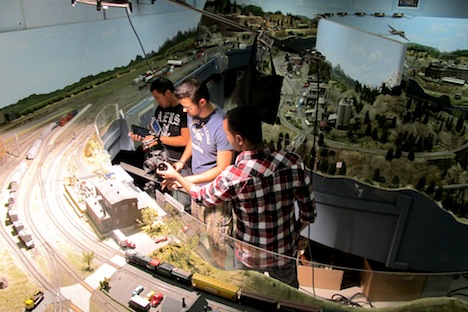
Our creative minds here at Element X Creative (Dallas, TX) were pretty stoked about the Association of Independent Commercial Producers (AICP) asking us to create this year’s Sponsor Reel for the Southwest show. The creative carte blanche was daunting given such a small window of time to concept and produce a 5-minute piece. Adding to the challenge were our own high expectations, not only in terms of storytelling, but also wanting to create something that had not been done in the history of the show.
During the conceptualization phase, one of our big breakthroughs was our lack of time in general. Short deadlines are notorious in this industry and we’ve all yearned to stop time for a second and catch our breath. This idea, fused with the childhood nostalgia of miniatures and train sets, became the base foundation for our story.

Beyond the short-notice four-week production window and already ongoing gigs in house, we tackled many other production hurdles. We decided to shoot the background plates on a Canon 60D for several reasons: (A) these DSLRs are just pumping out fantastic pictures, and the readily available lens selections make getting the right angle easy; (B) we wanted to shoot over-cranked at 60 fps to help sell the scale of the miniatures as larger than they were — also some of the cars/trains that we moved practically through the scene, would look more realistic slowed down a bit; and (C) the flip-out screen made it super easy to get into tighter spaces, and to see what was going on quickly.
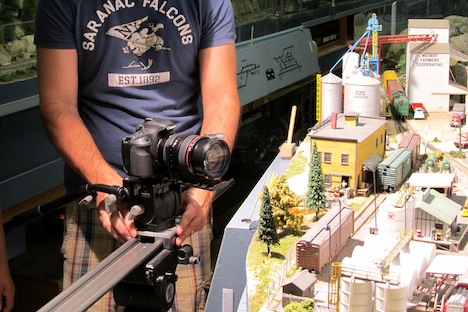
We also chose to shoot at a minimum of f/11, and when possible f/16 — I wanted to keep the DOF deeper, so it would seem more like it was photographed in the real world. We still wanted selective focus, but just not as much as you usually see when people show you photos of a miniature layout. This required us to dump a lot of light on the set to be able to shoot that stopped-down and still maintain a low ISO.
Last, we tried to get the camera as close as we could to ground level to mimic a large set — again with miniatures photographed that you might see, frequently it is shot from high above, since that is our natural vantage point in relation to them.
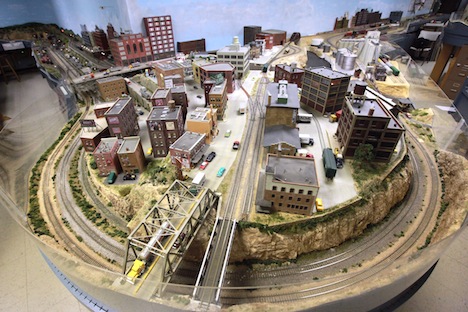
Using our internally developed OTTO rigging system, we put it through its paces quickly setting up dozens of characters and vehicles. Shooting such small miniatures with extreme focal lengths also made the 3D camera tracks challenging in certain shots. Logos were also pouring in at the last minute, so compositing was being handled up until the final hour.
Many late nights and take-out orders later, combined with a custom score and sound effects mix from Tequila Mockingbird, we came away with a unique animation that we are very proud of.
So take a peek at our latest and greatest! We hope you have as much fun watching it as our hero had while running around in the tiny world we created for him.
Official Press Release
CREDITS
Director — Brad Herbert
Executive Producers — Chad Briggs, Rick Perez
Producer — Amy Cass
Director of Photography — Brad Herbert
Location Crew — Luis Martinez, Jiss Kuruvilla
Location Manager — Robert Bray
CG Director — Eric J. Turman
Animation Director — Luis Martinez
Animators — Aaron Werntz, Steve “Q” Quentin, Andrea Thomas
Lead Modeler — Christopher McCabe
Modelers — Bobby Reynolds, Mathew Nith
Lead Rigger — Christopher McCabe
Rigger – Eric Turman
Editor — Luis Martinez, Brad Herbert
Lead Lighting Artist — Christopher McCabe
Lighting Artists — Dennis Kang, Mike Martin, Chad Briggs, Jason Moxon
Surfacing Artist — Christopher McCabe, Bobby Reynolds
Lead Compositor — Brad Herbert
Compositors — Dennis Kang, Mark Lopez ,Mike Martin, Laura Wallace, Christopher McCabe, Chad Briggs
Visual Effects — Dennis Kang, Mike Martin, Laura Wallace
Render Wrangler — Candace Morrish
Pipeline/Tools Programming — Steven Keiswetter
IT Director — Greg Glaser
Audio provided by Tequila Mockingbird
Executive Producer — Angie Johnson
Composer — Justin Tapp
Sound Design — Shayna Brown
Mix — Marty Lester
Background Plates : LMRA Railroad Activity
Special Thanks : Robert Bray (LMRA)
TOOLS
3D Package — Soft Image 2012 (.5)
Rigging — otto|rig — Proprietary Rigging Plug-in
Sculpting — Z Brush 4.2
Rendering — Arnold 1.13
Tracking — Syntheyes
Compositing — After Effects CS 5.5
Custom Scripts — Python
Cannon Cameras — 5D and 60D
Friday, September 2, 2011
Industrial Revolutions
Industrial Revolutions:re-blog from CoolHunting

As part of the U.K.'s Channel 4 series on urban action sports, Concrete Circus, Scotsman Danny MacAskill weaves, winds, hops, flips and otherwise impressively maneuvers his way through an abandoned ironworks factory in his native land. The entire collection of documentaries showcases specialized athletes in and out of their natural urban element, but few demand such widespread attention as MacAskill—as this clip proves.
Thanks to our friend Joey Lasley for the heads up, story via Pinkbike.

A new clip showing Danny MacAskill's unbelievable bike skills
As part of the U.K.'s Channel 4 series on urban action sports, Concrete Circus, Scotsman Danny MacAskill weaves, winds, hops, flips and otherwise impressively maneuvers his way through an abandoned ironworks factory in his native land. The entire collection of documentaries showcases specialized athletes in and out of their natural urban element, but few demand such widespread attention as MacAskill—as this clip proves.
Thanks to our friend Joey Lasley for the heads up, story via Pinkbike.
Ken Block's Gymkhana Four: The Hollywood Megamercial
Ken Block's Gymkhana Four: The Hollywood Megamercial:re-blog from CRBlog

Posted on YouTube on Tuesday, DC Shoes' latest short film showcasing their sponsored Gymkhana driver Ken Block has already clocked up over 3.5 million viewings. We thought we'd flag it up as there's some rather nice action-film-referencing typography in it – not to mention robotic sharks, deranged zombies, pyrotechnics, massive stunts and some pretty impressive driving skills...
For those of you that don't know what Gymkhana is (we didn't until an hour ago), it's a motorsport where competitors vie for the fastest time around a usually complex course – but also perform different driving techniques from spins, figure 8s and, where possible or necessary, drifting. Nothing will explain it better than this nine minute film - shot by director Ben Conrad (who created the opening title sequences for Zombieland / 30 Seconds or Less) of motion design, TV and branding agency, Logan in Los Angeles.
At nine minutes, the film is probably a little longer than it needs to be, but as a promotional film for the motorsport Gymkhana, the skills of driver Ken Block, and a plug for DC Shoes, well, it's not bad. The film-referencing typographic work in the opening sequence was created by designer Corey Holms who now works in house at Logan. Here are a few stills showing some of the frames from the opening sequence. Can you name all the films alluded to?


There's a behind the scenes, making-of film (but of course) too. Find it here
Credits
Director Ben Conrad
Production co Logan
Executive producer Matt Marquis
Line producer Rick Brown
Concept director Ken Block
Editor Volkert Besseling
Cinematography Stephen Blackman
Creative director Nate Morley
Creative consultant Brian Scotto
Post producer Pierre Nobile
Title design Corey Holms
Sound design Keith Ruggiero
Post supervisor Vincent Wauters
Original music by Money Mark
Posted on YouTube on Tuesday, DC Shoes' latest short film showcasing their sponsored Gymkhana driver Ken Block has already clocked up over 3.5 million viewings. We thought we'd flag it up as there's some rather nice action-film-referencing typography in it – not to mention robotic sharks, deranged zombies, pyrotechnics, massive stunts and some pretty impressive driving skills...
For those of you that don't know what Gymkhana is (we didn't until an hour ago), it's a motorsport where competitors vie for the fastest time around a usually complex course – but also perform different driving techniques from spins, figure 8s and, where possible or necessary, drifting. Nothing will explain it better than this nine minute film - shot by director Ben Conrad (who created the opening title sequences for Zombieland / 30 Seconds or Less) of motion design, TV and branding agency, Logan in Los Angeles.
At nine minutes, the film is probably a little longer than it needs to be, but as a promotional film for the motorsport Gymkhana, the skills of driver Ken Block, and a plug for DC Shoes, well, it's not bad. The film-referencing typographic work in the opening sequence was created by designer Corey Holms who now works in house at Logan. Here are a few stills showing some of the frames from the opening sequence. Can you name all the films alluded to?
There's a behind the scenes, making-of film (but of course) too. Find it here
Credits
Director Ben Conrad
Production co Logan
Executive producer Matt Marquis
Line producer Rick Brown
Concept director Ken Block
Editor Volkert Besseling
Cinematography Stephen Blackman
Creative director Nate Morley
Creative consultant Brian Scotto
Post producer Pierre Nobile
Title design Corey Holms
Sound design Keith Ruggiero
Post supervisor Vincent Wauters
Original music by Money Mark
Monday, August 8, 2011
Amon Tobin’s ISAM, Behind the Scenes; Ask Your Questions
Amon Tobin’s ISAM, Behind the Scenes; Ask Your Questions:re-blog from CreateDigitalMotion
By now, you’ve likely heard about the eye-popping, three-dimensional architectural live visuals for Amon Tobin’s immersively-transmedia tour ISAM LIVE. It’s clearly a new high water mark in live audiovisual experience.
So, how were the visuals done, and who did them? Derivative, the developers and visual collective behind the Touch Designer software that powered the show, have written up a detailed look at how the show works. Isabelle Rousset sends her article:
A Behind the Scenes Report on the Making of the Show Visuals and Delivery Systems
We’re in touch at CDM with Derivative and the folks who worked on the show, so here’s a unique opportunity: let us know what you want to know from them, whether technical detail or artistic inspiration, and we’ll take a selection of those reader questions to the artists directly. Fire away in comments.
In the meantime, here are some quick facts at a glance about the who, what, and why in the work:
The creators
V Squared Labs, North Hollywood CA
Director Vello Virkhaus (V Squared)
Designer and Programmer Peter Sistrom (V Squared)
Leviathan, Chicago + USA
Chief scientist Matt Daly (Leviathan)
Bryant Place (CPU / CyberPatrolUnit), Los Angeles


The tools
TouchDesigner runs the show, including projection mapping, media and effects, and integration with…
Microsoft Kinect
TouchOSC control from an iPad
One of the many reasons it’s cool – it’s four-dimensional.
Vello explains:
By now, you’ve likely heard about the eye-popping, three-dimensional architectural live visuals for Amon Tobin’s immersively-transmedia tour ISAM LIVE. It’s clearly a new high water mark in live audiovisual experience.
So, how were the visuals done, and who did them? Derivative, the developers and visual collective behind the Touch Designer software that powered the show, have written up a detailed look at how the show works. Isabelle Rousset sends her article:
A Behind the Scenes Report on the Making of the Show Visuals and Delivery Systems
We’re in touch at CDM with Derivative and the folks who worked on the show, so here’s a unique opportunity: let us know what you want to know from them, whether technical detail or artistic inspiration, and we’ll take a selection of those reader questions to the artists directly. Fire away in comments.
In the meantime, here are some quick facts at a glance about the who, what, and why in the work:
The creators
V Squared Labs, North Hollywood CA
Director Vello Virkhaus (V Squared)
Designer and Programmer Peter Sistrom (V Squared)
Leviathan, Chicago + USA
Chief scientist Matt Daly (Leviathan)
Bryant Place (CPU / CyberPatrolUnit), Los Angeles


The tools
TouchDesigner runs the show, including projection mapping, media and effects, and integration with…
Microsoft Kinect
TouchOSC control from an iPad
One of the many reasons it’s cool – it’s four-dimensional.
Vello explains:
4D in mathematics is a very abstract concept in which this additional dimension is indistinguishable, yet acknowledged. This unknown to me relates to the pronounced visual effect the mapped structure of Tobin creates for the viewer. What is fascinating is that we give viewers an idea of what it might be like to see beyond 3D space, to see all points simultaneously for both the exterior and the virtual interior of the set. The combination of this mapped effect and Amon’s music produced some very intense emotional reactions from people after the MUTEK performance.
Wednesday, August 3, 2011
The world's largest stop-motion animation
The world's largest stop-motion animation:re-blog Computerlove
Gulp' is a short film created by Sumo Science at Aardman, depicting a fisherman going about his daily catch. Shot on location at Pendine Beach in South Wales, every frame of this stop-motion animation was shot using a Nokia N8. There's also a making of. Cool.
Gulp. The world's largest stop-motion animation shot on a Nokia N8. on Vimeo

Gulp. The world's largest stop-motion animation shot on a Nokia N8. on Vimeo
Tuesday, June 7, 2011
Amon Tobin- The Worlds Most Amazing Dj Booth?
Amon Tobin- The Worlds Most Amazing Dj Booth?: "Sometimes I ask myself, what is the point of all this musical manipulation? How far should we take the exploration of music performance technology? Then some-one manages to combine talent, expertise, and vision all in one amazing application that reminds you- oh thats why. Because you never know when something magical will emerge.


Wednesday, April 27, 2011
The Magic of High Speed Photography: An Egg-Themed Tribute, an Affordable Camera for the Masses
The Magic of High Speed Photography: An Egg-Themed Tribute, an Affordable Camera for the Masses:re-blog from Create Digital Motion
Technologist magician Marco Tempest is back with another effort fusing traditional techniques and new gizmos. And I like how Marco celebrates Easter: not by painting eggs, but by filming them in motion on high-speed cameras.
This time, he calls our attention to George Karger, a pioneer in high-speed photography and amateur magic – a pre-digital forerunner to Mr. Tempest’s own practice.
The clip itself is Creative Commons-licensed, so if you want to work this into your next VJ set, you can.
But here’s where things get exciting: Marco is working with Swiss maker AOS Technologies to develop a low-cost high-speed camera that could spread the use of this kind of photography. Marco has already been doing some beautiful work with the prototype model, seen below; we also have a gallery of the camera itself. Rest assured, we’ll be following development here.
two seconds - cardistry from Marco Tempest on Vimeo.
two seconds - pressure from Marco Tempest on Vimeo.
More video:
Vimeo Album


Gallery: High-speed shooting
Next step: thinking of more things to shoot, which could in turn be offered up as more CC clips. Open to suggestions, let us know ideas in comments — and stay tuned for more on working with this camera.
Technologist magician Marco Tempest is back with another effort fusing traditional techniques and new gizmos. And I like how Marco celebrates Easter: not by painting eggs, but by filming them in motion on high-speed cameras.
This time, he calls our attention to George Karger, a pioneer in high-speed photography and amateur magic – a pre-digital forerunner to Mr. Tempest’s own practice.
A tribute to George Karger, a professional photographer (regularly contributed to Life magazine) he was the photographic illustrator for many magic books including the Stars of Magic series. But more importantly, he was the first magician ever to experiment with high-speed photography. Here’s to you, Mr. Karger, and to exploring the fourth dimension. (George Karger Died September 27, 1973)
This is the 1940 original: life.com/image/50336838
Music: Aleksi Virta “cosmos bossa” (archive.org)
Toys: AOS high speed camera @ 710fps, Nikon 50mm f/1.4, SIGMA 20mm f/1.8
copy me – remix me, music rights reserved. © 2011 newmagic communications, inc.
The clip itself is Creative Commons-licensed, so if you want to work this into your next VJ set, you can.
But here’s where things get exciting: Marco is working with Swiss maker AOS Technologies to develop a low-cost high-speed camera that could spread the use of this kind of photography. Marco has already been doing some beautiful work with the prototype model, seen below; we also have a gallery of the camera itself. Rest assured, we’ll be following development here.
two seconds - cardistry from Marco Tempest on Vimeo.
two seconds - pressure from Marco Tempest on Vimeo.
More video:
Vimeo Album
The AOS prototype camera with magician Marco Tempest. Courtesy Marco; used by permission.
Gallery: High-speed shooting
Next step: thinking of more things to shoot, which could in turn be offered up as more CC clips. Open to suggestions, let us know ideas in comments — and stay tuned for more on working with this camera.
Subscribe to:
Posts (Atom)