Avengers Visual FX:
I just finished recording 3 hours of training for the Explosive Train sequence so while I finish editing that… check out this amazing demo from ILM on the VFX work for The Avengers. 3 Hours of recorded training is probably 1.5 hours after editing out rendering and bad jokes. Stay tuned, it’s a big series.

Showing posts with label technology. Show all posts
Showing posts with label technology. Show all posts
Wednesday, February 27, 2013

VTLZR @Zenith Paris
VTLZR @Zenith Paris:re-blog from 1024 Architecture
Wow, just wow.
We had an amazing show this week end at the Paris Zenith – the show was sold out -
Here are some pictures, which unfortunately do not properly render the mood of the show, as the lights were moving amazingly fast, in sync to the music.
Since we were playing “at home”, we had the opportunity to add a few fixtures to the setup, namely 20 Martin Viper, 20 more Shaprys (60 in total) and a grand total of 32 Atomic Strobs, all remotely controlled by Vitalic’s computer – on stage – from Ableton Live.
It was the perfect show according to our standards, everything went fine, despite 2 computer reboot during the show – thanks to the super tech team nobody noticed – and some heavy hum coming from the Midi cable … grrrr
Next show is in Cran-Montana, Swiss.


And the last one, which looks like a proof that 1024 is actually bending the light … ;) Space Warp anyone ?

Wow, just wow.
We had an amazing show this week end at the Paris Zenith – the show was sold out -
Here are some pictures, which unfortunately do not properly render the mood of the show, as the lights were moving amazingly fast, in sync to the music.
Since we were playing “at home”, we had the opportunity to add a few fixtures to the setup, namely 20 Martin Viper, 20 more Shaprys (60 in total) and a grand total of 32 Atomic Strobs, all remotely controlled by Vitalic’s computer – on stage – from Ableton Live.
It was the perfect show according to our standards, everything went fine, despite 2 computer reboot during the show – thanks to the super tech team nobody noticed – and some heavy hum coming from the Midi cable … grrrr
Next show is in Cran-Montana, Swiss.
And the last one, which looks like a proof that 1024 is actually bending the light … ;) Space Warp anyone ?
Wednesday, January 23, 2013
Cool Hunting Video Presents: The Planetarium Projector Museum: A gaze inside the world's largest collection of planetarium projectors
Cool Hunting Video Presents: The Planetarium Projector Museum: A gaze inside the world's largest collection of planetarium projectors:

There are many beautiful things to see on the drive into Big Bear Lake, CA but one of the more interesting and unknown is the Planetarium Projector Museum.
Cool Hunting Video Presents: The Planetarium Projector Museum from Cool Hunting on Vimeo.

There are many beautiful things to see on the drive into Big Bear Lake, CA but one of the more interesting and unknown is the Planetarium Projector Museum.
Cool Hunting Video Presents: The Planetarium Projector Museum from Cool Hunting on Vimeo.
Thursday, November 22, 2012
Automatically Projection Mapping a 3D, Moving Object: White Kanga Show Stunning Tech

Automatically Projection Mapping a 3D, Moving Object: White Kanga Show Stunning Tech:
Hide’n'Seek – Technology Demo from White Kanga on Vimeo.
Automatically map an object with a projector. Keep the mapping working as the object moves. And, oh yeah, look damned fine while doing it.
That’s the neat trick Poland-based White Kanga have pulled off, powered by TouchDesigner. We’ve been following their work before:
Robotic Mapping Pulls a Model Building, Tron-Like, Into the Virtual
Projection Mapping, with Robotics, Goes Further to Augmenting Reality: MPS Demo [TouchDesigner]
Here, we get to really see it in action. It doesn’t hurt that you get cool graphics visualizing the calibration. It’s an internal tool, but it demonstrates a lot of what’s possible.
I was in Poland for their national day yesterday, but watching this video makes me want to start waving around the white and red flag and cheering on this crew. (Or, if they like, whatever flag/mascot they choose.) Brilliant work.
Sunday, October 28, 2012
Mapping, Beyond Projectors: ArKaos Adds Serious Plug-and-Play Pixel, LED Features
Mapping, Beyond Projectors: ArKaos Adds Serious Plug-and-Play Pixel, LED Features:re-blog from CreateDigitalMotion

ArKaos promises to make output to LED surfaces easier. Marco from ArKaos explains what we see here: “[This is the] Kling-Net mapper working with MediaMaster in Simple mode. In simple mode each layer can be sent to the video mapper or the Kling-Net mapper. In this screen shot layer 1 goes to Kling-Net and layer 2 goes to the video surface.”
It sounds like the computer system on a Bird of Prey on Star Trek, but Kling-Net is at the heart of where VJ and media server maker ArKaos – and a lot of the live visual world – is headed. Forget the phrase “projection mapping,” and think “video mapping” and “pixel mapping.” Yes, projectors will still be a big part of live visuals. But they’ll be just one outlet for visual performance, alongside increasingly-sophisticated LED lighting. And LED lighting is increasingly looking like a major choice in installations.
Let me put that in less technical terms: more bright shiny, shiny from the LEDs.
So, LED is amazing technology for visualization. But it can also be amazingly hard to set up. The race now becomes about how to make that technology easier to access. ArKaos’ play is doing just that with Kling-Net. (Kahplah! Sorry, I’ll stop that now.)
It’s not rocket science to do cool stuff like this with pricey media servers sold for expensive applications. But what about the independent visual artists, the experimental creators pushing the envelope? The good news is, ArKaos is bringing the same media server tech back to GrandVJ, an app that’s far more affordable.
Marco Hinic is engine architect and CEO of ArKaos and creator of Kling-Net. (I love that, in this business, the engineers typically run the show.) Marco tells CDM about what their goals are for the tech:

Kling-Net is a complex technology, so I’ll do two things. First, I’ll direct you to ArKaos’ site that explains how this works:
Kling-Net @ ArKaos
Second, I ask you to tell us what your experience is with these kinds of applications, and what you’d like to know. We’re fortunate enough to get to talk directly to Marco about the technology he engineered, so, seriously, ask anything. I look forward to your questions.
http://arkaos.net/


ArKaos promises to make output to LED surfaces easier. Marco from ArKaos explains what we see here: “[This is the] Kling-Net mapper working with MediaMaster in Simple mode. In simple mode each layer can be sent to the video mapper or the Kling-Net mapper. In this screen shot layer 1 goes to Kling-Net and layer 2 goes to the video surface.”
Let me put that in less technical terms: more bright shiny, shiny from the LEDs.
So, LED is amazing technology for visualization. But it can also be amazingly hard to set up. The race now becomes about how to make that technology easier to access. ArKaos’ play is doing just that with Kling-Net. (Kahplah! Sorry, I’ll stop that now.)
It’s not rocket science to do cool stuff like this with pricey media servers sold for expensive applications. But what about the independent visual artists, the experimental creators pushing the envelope? The good news is, ArKaos is bringing the same media server tech back to GrandVJ, an app that’s far more affordable.
Marco Hinic is engine architect and CEO of ArKaos and creator of Kling-Net. (I love that, in this business, the engineers typically run the show.) Marco tells CDM about what their goals are for the tech:
Kling-Net has been designed to create plug and play LED devices and we are converting more and more manufacturers to work with us. There is nothing else like that on the market and we hope it will enable a new level of integration for many users.The other side of the equation, apart from ArKaos’ software, is the lighting fixtures. Recently, ArKaos announced Chauvet is bringing Kling-Net support to their lighting, which you can see in the video and image below.
The good news is that we will also support Kling-Net in GrandVJ. Indeed this why we are late with releasing GrandVJ, while working on the video mapper in MediaMaster we added the functionality where a layer can be sent to a mapping surface and / or to Kling-Net – ArtNet. To support that in GrandVJ we need to rework it’s core engine and that’s what we are doing now… We are now looking forward to present that at NAMM with ADJ. Ed.: NAMM is the music trade show in California held in January. Mark your calendars. -PK

Chauvet’s EPIX strip product, as seen in a permanent club installation at Ft. Lauderdale, Florida’s club Off the Hookah.
http://www.chauvetlighting.com/Kling-Net is a complex technology, so I’ll do two things. First, I’ll direct you to ArKaos’ site that explains how this works:
Kling-Net @ ArKaos
Second, I ask you to tell us what your experience is with these kinds of applications, and what you’d like to know. We’re fortunate enough to get to talk directly to Marco about the technology he engineered, so, seriously, ask anything. I look forward to your questions.
http://arkaos.net/
Tuesday, October 16, 2012
Carrot HD Video Mixer + Controller, in Edirol V4-Style Layout, Coming Soon [Exclusive Prototype Details]
Carrot HD Video Mixer + Controller, in Edirol V4-Style Layout, Coming Soon [Exclusive Prototype Details]:re-blog from Create Digital Motion
HD Rabbit – Introduction from carrotvideo on Vimeo.
I keep waiting to write this headline and talk about something that’s shipping. But it might at last happen. We might finally be able to cover an HD mixer that lets you easily plug in two computers and mix as easily as you have done for years with analog inputs. It’s called the HD Rabbit, from upstart Carrot Video, designed by VJs for VJs – and yes, you might even be able to afford it.
You know what you want. You’ve known for a long time. You want a mixer that works in HD, one that handles multiple digital resolutions and multiple outputs, and lets you switch and mix at will. And you want it to work with computer inputs, and control computer software. Basically, you want to have the feeling you had when you used analog, standard-def mixers like Edirol’s classic V4, in something that works with computers running at modern resolutions.
Also, you want it to be something you can actually afford.
Carrot Video today gives us the first look at an HD mixer that might have you pinching yourself to see if you’re dreaming. First, let’s get the bad news out of the way first: this is a prototype, not a complete product, and Carrot tell CDM that they don’t want to suggest that they’re ready for mass production. They’re working on a small test batch. (I’m afraid I just unleashed a lot of requests from our readers to get into that batch. Sorry, guys. Well, you’ll have some good choices.)
But, then there’s the good news. It’s clear from the moment you see the design, with V4-style t-bar, a simple, VJ-friendly layout, and switching features. And then it just gets better from there:
On the other hand, I think the effort to make something integrated is itself admirable, even if the results may not satisfy everyone. It also suggests the technology is ready for mass-marketed, all-in-one products, with this as an excellent prototype of what they might look like.
(We’ll look at DIY options later this week, and explain some of the underlying technology. And I’m sure Carrot will read your feedback.)

*$#&*, yes. A conventional mixer body, with HD brains. Images courtesy Carrot Video.
Weight: 2.5 kg, fit into a compact 28 cm by 23 cm by 9 cm aluminum metal frame.
What will it cost?
Pricing is not yet announced, but Carrot Video tells CDM readers should look at the pricing of the Edirol V-8. That means we’re somewhere in the viscinity of 2000 USD / EUR. It’s a magical price point that in the past allowed VJs and independent artists, not just big institutions, to first invest in mixing. If Carrot can hit their price target and ship in greater volumes, the design could start that revolution all over again for HD mixing.
What do you get?
Early production information seen by CDM shows the mixer including the scaler – so you don’t have to buy extra hardware. The all-in-one box includes, as well, an RS232 patch cable, and cable/adapters for DVI, VGA, and HDMI.
Who’s behind it?
It’ll come as little surprise that VJs designed this thing. And you may already know the VJs: visualists Merijn Meijers (KBK), Karl Klomp (Molta), and Joris de Jong (Hybrid Visuals) are founders and developers, with Marc Snip (Embed Engineering) doing the hardware work.
Official information (though we’ve already got extra details here exclusive on CDM you won’t find there, with more to come):
http://carrotvideo.com/info/
Got questions for the creators? Don’t be shy about asking them here, as we’ll be following up. And yes, we hope to test this in person as soon as possible.
But congrats to this team for getting to this prototype phase. We can’t wait to use the finished tool.


HD Rabbit – Introduction from carrotvideo on Vimeo.
I keep waiting to write this headline and talk about something that’s shipping. But it might at last happen. We might finally be able to cover an HD mixer that lets you easily plug in two computers and mix as easily as you have done for years with analog inputs. It’s called the HD Rabbit, from upstart Carrot Video, designed by VJs for VJs – and yes, you might even be able to afford it.
You know what you want. You’ve known for a long time. You want a mixer that works in HD, one that handles multiple digital resolutions and multiple outputs, and lets you switch and mix at will. And you want it to work with computer inputs, and control computer software. Basically, you want to have the feeling you had when you used analog, standard-def mixers like Edirol’s classic V4, in something that works with computers running at modern resolutions.
Also, you want it to be something you can actually afford.
Carrot Video today gives us the first look at an HD mixer that might have you pinching yourself to see if you’re dreaming. First, let’s get the bad news out of the way first: this is a prototype, not a complete product, and Carrot tell CDM that they don’t want to suggest that they’re ready for mass production. They’re working on a small test batch. (I’m afraid I just unleashed a lot of requests from our readers to get into that batch. Sorry, guys. Well, you’ll have some good choices.)
But, then there’s the good news. It’s clear from the moment you see the design, with V4-style t-bar, a simple, VJ-friendly layout, and switching features. And then it just gets better from there:
- A mixer/scaler, a switcher, and a controller for your software.
- Built on the TvOne 1t-C2-750 scaler, it means you’re ready to handle any output resolution – even a strange one – at a moment’s notice, up to 2048×2048.
- Use LED walls, multiple projectors (via Triplehead2go, etc.), whatever.
- Mix (including “battle” mixing), key, color correct, add effects.
- Create custom controller “skins” for controlling software.
- Output OSC (OpenSoundControl, over UTP, and Artnet), DMX, and MIDI, plus RS-232.
- Input DMX and OSC.
- Freely-assignable control layout with 15 buttons, 3 knobs. (three user skins/presets, editable from your desktop computer)
- 2x DVI-I inputs, with RGBHV, RGBS, RGsB, and YPbPr support.
- Per-pixel or percentage scaling control, variable image zoom and shrink, dual picture-in-picture.
- Chromakey, lumakey.
On the other hand, I think the effort to make something integrated is itself admirable, even if the results may not satisfy everyone. It also suggests the technology is ready for mass-marketed, all-in-one products, with this as an excellent prototype of what they might look like.
(We’ll look at DIY options later this week, and explain some of the underlying technology. And I’m sure Carrot will read your feedback.)

*$#&*, yes. A conventional mixer body, with HD brains. Images courtesy Carrot Video.
Weight: 2.5 kg, fit into a compact 28 cm by 23 cm by 9 cm aluminum metal frame.
What will it cost?
Pricing is not yet announced, but Carrot Video tells CDM readers should look at the pricing of the Edirol V-8. That means we’re somewhere in the viscinity of 2000 USD / EUR. It’s a magical price point that in the past allowed VJs and independent artists, not just big institutions, to first invest in mixing. If Carrot can hit their price target and ship in greater volumes, the design could start that revolution all over again for HD mixing.
What do you get?
Early production information seen by CDM shows the mixer including the scaler – so you don’t have to buy extra hardware. The all-in-one box includes, as well, an RS232 patch cable, and cable/adapters for DVI, VGA, and HDMI.
Who’s behind it?
It’ll come as little surprise that VJs designed this thing. And you may already know the VJs: visualists Merijn Meijers (KBK), Karl Klomp (Molta), and Joris de Jong (Hybrid Visuals) are founders and developers, with Marc Snip (Embed Engineering) doing the hardware work.
Official information (though we’ve already got extra details here exclusive on CDM you won’t find there, with more to come):
http://carrotvideo.com/info/
Got questions for the creators? Don’t be shy about asking them here, as we’ll be following up. And yes, we hope to test this in person as soon as possible.
But congrats to this team for getting to this prototype phase. We can’t wait to use the finished tool.
Gallery


Monday, September 24, 2012
Apple Introduces Four Television Spots for the iPhone 5
Apple Introduces Four Television Spots for the iPhone 5: With the launch of the iPhone 5, Apple has started running a full slate of television ads promoting the product. Typical with Apple advertising, all the spots focus on the features of the iPhone 5 and iOS, rather than price. They are voiced by Jeff Daniels, currently starring as Will McAvoy on HBO's Newsroom.
One is focused on the new EarPod headphones, while another shows off the new Panorama feature in iOS 6, and a third touts the larger screen of the iPhone 5. The fourth ad shows how the iPhone 5 is the perfect size for "your thumb", a subtle jab at the larger screens of some Android phones that can be difficult to use with one hand.
One is focused on the new EarPod headphones, while another shows off the new Panorama feature in iOS 6, and a third touts the larger screen of the iPhone 5. The fourth ad shows how the iPhone 5 is the perfect size for "your thumb", a subtle jab at the larger screens of some Android phones that can be difficult to use with one hand.
Monday, September 10, 2012
Apple's Yerba Buena Decoration Shows Stretched iOS Icons, Possibly Hinting at Taller iPhone 5
Apple's Yerba Buena Decoration Shows Stretched iOS Icons, Possibly Hinting at Taller iPhone 5:

Photo by Luis Gutierrez, Developer of Super Apps
Apple has finished decorating the front facade of the Yerba Buena center in preparation for their September 12th media event. Apple is expected to announce the iPhone 5 at that event. At initial glance, the front decoration seems to show no obvious clues as to their announcements.
However, one eagle eyed MacRumors forum visitor believes the facade show stretched iOS icons. Zaym points out that you can see stretched versions of iOS icons including Game Center, iTunes, Music and App Store in the image and provides an example image.
After taking the above image and skewing it and shrinking it, we've verified his findings. Several icons are clearly recognizable in their un-stretched form:

Game Center (upside down above), iTunes and Music icons:

Of course, speculation on the reason for the stretched icons points to the long-running rumors that Apple will be introducing a taller iPhone with a 4" diagonal screen. Our complete iPhone 5 roundup details everything we expect in the new iPhone.
Update: Another take on the icons from roosternugget:


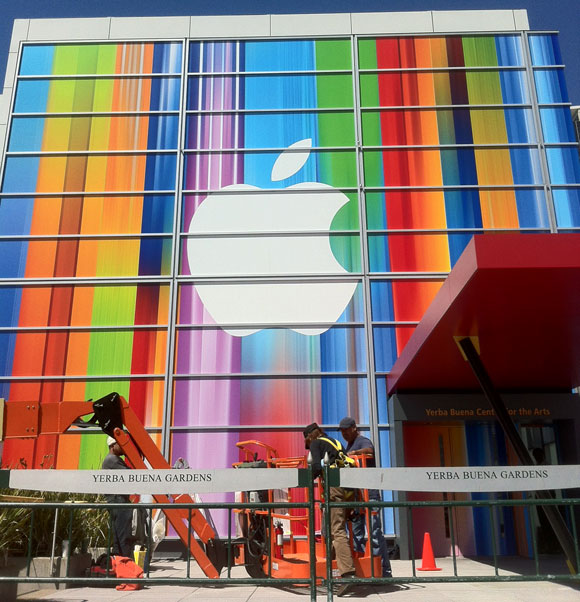
Photo by Luis Gutierrez, Developer of Super Apps
Apple has finished decorating the front facade of the Yerba Buena center in preparation for their September 12th media event. Apple is expected to announce the iPhone 5 at that event. At initial glance, the front decoration seems to show no obvious clues as to their announcements.
However, one eagle eyed MacRumors forum visitor believes the facade show stretched iOS icons. Zaym points out that you can see stretched versions of iOS icons including Game Center, iTunes, Music and App Store in the image and provides an example image.
After taking the above image and skewing it and shrinking it, we've verified his findings. Several icons are clearly recognizable in their un-stretched form:
Game Center (upside down above), iTunes and Music icons:

Of course, speculation on the reason for the stretched icons points to the long-running rumors that Apple will be introducing a taller iPhone with a 4" diagonal screen. Our complete iPhone 5 roundup details everything we expect in the new iPhone.
Update: Another take on the icons from roosternugget:
Wednesday, August 8, 2012
Philips Thinks We Want a Giant Wave of LED Panels, Controlled By iPad – And They’re Correct
Philips Thinks We Want a Giant Wave of LED Panels, Controlled By iPad – And They’re Correct:

LivingSculpture 3D module system from WHITEvoid on Vimeo.
Visualism has gone far beyond just projection. Lighting continues to dazzle, blurring the lines between the image, object, pixel, and display, as LED panels produce new three-dimensional forms and animation.
In a spectacular project for lighting giant Philips, Berlin-headquarted White Void, the interactive shop led by Christopher M. Bauder, produces a giant wave of screens, all controlled via iPad. (Bauder you might recall from a collaboration with Robert Henke, featured on Create Digital Music in 2009 in view and interview, in stunning, fanciful arrays of mechanized balloons and accompanying electronic score.)
Details:
at whitevoid.com
And yes, Philips, I’d like one for my evil lair once I come up with some truly unethical way of building one. In the meantime: LED’s future is bright for visual artists, no question.


LivingSculpture 3D module system from WHITEvoid on Vimeo.
Visualism has gone far beyond just projection. Lighting continues to dazzle, blurring the lines between the image, object, pixel, and display, as LED panels produce new three-dimensional forms and animation.
In a spectacular project for lighting giant Philips, Berlin-headquarted White Void, the interactive shop led by Christopher M. Bauder, produces a giant wave of screens, all controlled via iPad. (Bauder you might recall from a collaboration with Robert Henke, featured on Create Digital Music in 2009 in view and interview, in stunning, fanciful arrays of mechanized balloons and accompanying electronic score.)
Details:
The “LivingSculpture 3D module system” is the latest addition to the Philips “LivingSculpture” product family. WHITEvoid designed a modular plug and play OLED system that allows for infinite variations in layout and arrangement of a ceiling or wall lighting installation. The highly flexible system consists of an online configurator to create and order the individual arrangement, a plug and play modular hardware system and an iPad controlled light animation application.It’s sumptuous, immersive, sculptural eye candy. (I’m filing this in my Neo-Baroque file.)
at whitevoid.com
And yes, Philips, I’d like one for my evil lair once I come up with some truly unethical way of building one. In the meantime: LED’s future is bright for visual artists, no question.
Monday, August 6, 2012
Deadmau5′s New Performance DJ Setup
re-blog from djtechtools.com
 Over the weekend at Toronto’s Veld Music Festival, Deadmau5 showed off part of brand new live performance setup (see below for full video) that features a massive touch screen with controls for individual note triggering as well as loop triggering and level/parameter adjustment. While visually very similar to a performance of his at Earl’s Court a year and a half ago (which featured a touchscreen Holodesk), the interface and technology here are clearly different.
Deadmau5 also announced over the weekend that he’ll be cooling down in terms of new high-intensity projects, so it could be a bit before we see more of this interface onstage.
WARNING: Turn down your volume before watching this video, as it has highly distorted sound!
Monday, July 30, 2012
Touching Beams of Light: An Otherworldly Laser Interaction Prototype
NOW THIS IS SOMETHING NEW! (re-blog from Create Digital Motion)
Touching Beams of Light: An Otherworldly Laser Interaction Prototype:
Laser interaction prototype from jayson on Vimeo.
Interaction design isn’t just input. Output can transform a simple demo into something that seems to bend reality.
Melbourne-based artist Jayson Haebich sends over a laser interaction prototype he’s creating. The results seem like science fiction, as though he’s opening jump gates with his fingers.
It’s almost exclusively for aesthetic effect, but that sense of light, sound, and space coming together and then being gently pulled apart is more than enough. Technical details:
http://jaysonh.com/laser.html

Touching Beams of Light: An Otherworldly Laser Interaction Prototype:
Laser interaction prototype from jayson on Vimeo.
Interaction design isn’t just input. Output can transform a simple demo into something that seems to bend reality.
Melbourne-based artist Jayson Haebich sends over a laser interaction prototype he’s creating. The results seem like science fiction, as though he’s opening jump gates with his fingers.
It’s almost exclusively for aesthetic effect, but that sense of light, sound, and space coming together and then being gently pulled apart is more than enough. Technical details:
The software used to control the laser was created using OpenFrameworks and C++ by Jayson Haebich and uses an Xbox kinect to do 3d tracking. The software creates the lasers beams by sending vectors to the laser via a DAC. The lasers position is then calibrated to the 3-Dimensional field of data viewed from the kinect, which is used to detect when intersections between users and the laser beams occur. These interactions then trigger effects such as colour changes or causing the beams to move which gives users the feeling of being able to touch the laser beams.Jason, when you get further with this, you can bet we’ll want to see it.
http://jaysonh.com/laser.html
Monday, June 25, 2012
Artisan / UVA: Sprint “The Dream”
Artisan / UVA: Sprint “The Dream”:
Do androids dream of electric sheep? Do cell phones dream of interactive on-screen cinema experiences? Artisan (part of UVA) used their in-house content mapping framework, d3, to create a stunning cell phone warning. The making-of that shows off the practical effects they filmed is particularly impressive.
Hat tip to creativeapplications.net.
Team Sprint – Campaign Credits:
Client/Ad or Campaign: Sprint’s “Dream” Cinema PSA for NCM Theaters
Agency: Team Sprint – Leo Burnett & Digitas
Chief Creative Officer: Susan Credle
Creative Directors: Michael Boychuk, Kevin Drew Davis, Mark Moll
EVP, Executive Director of Production: Chris Rossiter
Producer: Bryan Litman, Amanda Riley
Account Team: Vanessa Mackey, Julie Holton and Melissa Wolf
Production Company: Artisan
Director: Artisan and Chris Turner
VFX/SPX: Artisan
Editorial: Trim Edit
Editor: Paul Hardcastle
Director of Photography: James Medcraft
Sound Design: Scanner
Posted on Motionographer
Do androids dream of electric sheep? Do cell phones dream of interactive on-screen cinema experiences? Artisan (part of UVA) used their in-house content mapping framework, d3, to create a stunning cell phone warning. The making-of that shows off the practical effects they filmed is particularly impressive.
Hat tip to creativeapplications.net.
Team Sprint – Campaign Credits:
Client/Ad or Campaign: Sprint’s “Dream” Cinema PSA for NCM Theaters
Agency: Team Sprint – Leo Burnett & Digitas
Chief Creative Officer: Susan Credle
Creative Directors: Michael Boychuk, Kevin Drew Davis, Mark Moll
EVP, Executive Director of Production: Chris Rossiter
Producer: Bryan Litman, Amanda Riley
Account Team: Vanessa Mackey, Julie Holton and Melissa Wolf
Production Company: Artisan
Director: Artisan and Chris Turner
VFX/SPX: Artisan
Editorial: Trim Edit
Editor: Paul Hardcastle
Director of Photography: James Medcraft
Sound Design: Scanner
Posted on Motionographer
Wednesday, April 11, 2012


Tuesday, April 10, 2012
Mapping AV to Architecture, a Touchscreen Project Puts Participants in Control in Chicago [Video]
Mapping AV to Architecture, a Touchscreen Project Puts Participants in Control in Chicago [Video]:

Mapping projections to architecture, and connecting music to visual metaphors are nothing new. But many of these projects leave the control to performers; audience members simply stand back and watch. In a project for HP promoting their TouchSmart PCs, interactive artists ceded that control to participants. Instead of the computers being in the hands of the performers, they’re touchable by anyone, for an open, collaborative experience of the work.
The project makes use of a number of ingredients. The HP TouchSmart PC provides a big, touchable display, much larger (though less mobile) than a tablet like the iPad. On the software side, custom interfaces for the participants manipulate sound and visuals built in not one but two visual programming languages: Max/MSP and (Windows-only) TouchDesigner.
The project is the work of two firms, Waveplant and Leviathan. Joel Corelitz writes from the Waveplant side to share the work with CDM readers:
More information:
http://www.waveplantstudios.com/HP-Play-Big
http://www.waveplantstudios.com/HP-Hear-There-Everywhere
Agency for this project:
designkitchen


Mapping projections to architecture, and connecting music to visual metaphors are nothing new. But many of these projects leave the control to performers; audience members simply stand back and watch. In a project for HP promoting their TouchSmart PCs, interactive artists ceded that control to participants. Instead of the computers being in the hands of the performers, they’re touchable by anyone, for an open, collaborative experience of the work.
The project makes use of a number of ingredients. The HP TouchSmart PC provides a big, touchable display, much larger (though less mobile) than a tablet like the iPad. On the software side, custom interfaces for the participants manipulate sound and visuals built in not one but two visual programming languages: Max/MSP and (Windows-only) TouchDesigner.
The project is the work of two firms, Waveplant and Leviathan. Joel Corelitz writes from the Waveplant side to share the work with CDM readers:
My company (Waveplant) collaborated with Leviathan to create an OSC-controlled projection mapping installation for HP to promote their TouchSmart line of PCs. Participants controlled the sound and visuals via the PCs with custom-created OSC interfaces (in TouchDesigner). Max/MSP was used to drive the audio and the visuals.Here’s an extended documentary of the project, with requisite shots of Chicago’s famous L train. (For some of you, that should cause a Pavlovian hunger for deep dish pizza.)
I was responsible for all the audio creation as well as the Max/MSP programming, and Leviathan created the visuals and handled the projection mapping.
Just to reiterate – Leviathan is the company that’s responsible (amongst many other things) for the visual component of Amon Tobin’s ISAM tour. My company / personal brand Waveplant was responsible for all the audio in this project as well as the maxMSP programmed back-end that was responsible for the live audio interactivity. Leviathan designed interfaces in Touch Designer that transmit information to Max/MSP. Max/MSP would respond with audio in various ways while sending OSC information back to those interfaces and touch designer which reflected those musical changes visually.
As an artist, I’m really excited about these kinds of marketing efforts. They’re incredible opportunities to push creative boundaries and subvert the more “linear” forms of advertising that we’re used to. What’s also really unique about them is the way they let the art stand on its own while at the same time involving the product in a hands-on (literally) capacity.
More information:
http://www.waveplantstudios.com/HP-Play-Big
http://www.waveplantstudios.com/HP-Hear-There-Everywhere
Agency for this project:
designkitchen
Sunday, February 26, 2012
Antilop: Coca-Cola’s 125th Anniversary Exhibition’s Future Room
Antilop: Coca-Cola’s 125th Anniversary Exhibition’s Future Room:

Istanbul creative agency Antilop created this audio-visual and interactive installation for Coca-Cola’s 125th Anniversary Exhibition’s Future Room concept for Turkish modern-art museum santralistanbul.
Friday, February 24, 2012
Projection Mapping Meets Turntablism: Serato DJing and Live Visual Feedback
Projection Mapping Meets Turntablism: Serato DJing and Live Visual Feedback:re-blog from Create Digital Motion
Projection Mapping Onto Turntables from E.N.S. on Vimeo.

Projection Mapping Onto Turntables from E.N.S. on Vimeo.
Rooted in pre-digital tradition, the turntables and mixer here get a different kind of digital upgrade: sound-responsive visuals transform the decks.
Built by Austin, Texas-based student Mark Morris, artist E.N.S., and collaborators, this work in progress demonstrates what happens if you point the projector directly at the DJ’s rig. Cleverly, they map the platters themselves as they rotate, as well as add interface elements from the DJ software and responsive audio waveforms. From Mark:
This is a projection mapping project we’ve been working on for about a month as of uploading.
It’s a user interface for Serato Scratch Live that is vinyl rotation-reactive, as well as sound-reactive, and makes it possible to mix using Serato without having to look at your computer screen whatsoever. We have real-time waveforms streaming across our mixers, or our vinyl platters, and we have started to incorporate video effects that are controlled by [Nintendo] Wii remotes. We are also working on controlling effects with motion capturing using a camera.
Much more to come!
The Song from the video was made by one of the creators of all the cool stuff you saw in the video: Mark Morris
Music from E.N.S. is available on Facebook.
Thanks to Francis Preve (Academik Records, Keyboard Magazine), who’s fortunate to have Mark as a student and points this our way.
We’ll have more as they get further along, but this is already looking great.
Update – via comments, here’s another instance of projection mapping onto decks, by MrGeeBee, a Luzern, Switzerland-based developer moonlighting as DJ. I wouldn’t be surprised if there are other examples, as well. Heck, I hope there are – go make more, folks.
Thursday, February 2, 2012
Scanimate Effects Excerpt
These experts are talking about early graphics and motion designs that are available back in 60's-70'. One of the animation generator machine that only 8 of them were build and cost 1 mill was "SCANIMATE" I just love to see the development (evolution) of what we have going on today. Back then just a flash of graphic - machine generate was enough to surprise people and become a talk of the town. How about now?


Tuesday, January 24, 2012
Steve Jobs Met with Light Field Camera (Lytro) Company's CEO
Steve Jobs Met with Light Field Camera (Lytro) Company's CEO:

In the upcoming Inside Apple book by Adam Lashinsky, it's revealed that Steve Jobs had expressed interest and subsequently met with the CEO of Lytro, the makers the first light field camera. The relevant book quote posted by 9to5Mac states:
Light field cameras are a different take on photography by capturing "the entire light field" and saving all that information into a single file. Photographers can then edit the file afterwards in a number of unique ways -- including refocusing the image. This video walks through this unique ability:
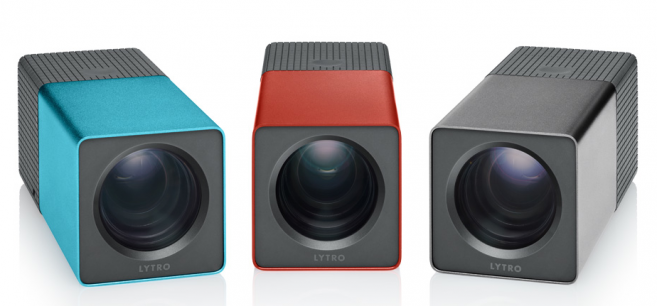
One of the limitations in the early light field cameras is a relatively low resolution. The first Lytro camera produces final photos of only 1.2 megapixels (1,080x1,080). The cameras also don't take any video and start at $399 for an 8GB model. The camera carries an elongated form factor that seems to be a result of the unusual optics required.
Given the hype surrounding the technology, it's perhaps no surprise that Steve Jobs found interest in meeting with the young company. That meeting, however, is getting special attention due to the fact that Walter Isaacson had said that Jobs wanted to reinvent television, textbooks and photography.
Apple just released their first digital textbooks for the iPad, and is expected to get into the television space. Apple's future goals for photography, however, remain unclear. Apple includes a digital camera its iPhones and has made progressive improvements in camera quality over the past few generations. While Apple no longer makes a standalone digital camera, they were one of the first to product a consumer targeted digital camera back in 1994.
Given the popularity of smartphones and the subsequent decline of point and shoot camera popularity, we'd expect any future Apple movement into photography would be centered around the iPhone.

In the upcoming Inside Apple book by Adam Lashinsky, it's revealed that Steve Jobs had expressed interest and subsequently met with the CEO of Lytro, the makers the first light field camera. The relevant book quote posted by 9to5Mac states:
The company’s CEO, Ren Ng, a brilliant computer scientist with a PhD from Stanford, immediately called Jobs, who picked up the phone and quickly said, “if you’re free this afternoon maybe we would could get together.” Ng, who is thirty-two, hurried to Palo Alto, showed Jobs a demo of Lytro’s technology, discussed cameras and product design with him, and, at Jobs’s request, agreed to send him an email outlining three things he’d like Lytro to do with Apple.Lytro received a lot of press last year when the first of its light field cameras went on sale in October. The product even received Popular Science's 2011 Innovation of the Year.
Light field cameras are a different take on photography by capturing "the entire light field" and saving all that information into a single file. Photographers can then edit the file afterwards in a number of unique ways -- including refocusing the image. This video walks through this unique ability:
One of the limitations in the early light field cameras is a relatively low resolution. The first Lytro camera produces final photos of only 1.2 megapixels (1,080x1,080). The cameras also don't take any video and start at $399 for an 8GB model. The camera carries an elongated form factor that seems to be a result of the unusual optics required.
Given the hype surrounding the technology, it's perhaps no surprise that Steve Jobs found interest in meeting with the young company. That meeting, however, is getting special attention due to the fact that Walter Isaacson had said that Jobs wanted to reinvent television, textbooks and photography.
Apple just released their first digital textbooks for the iPad, and is expected to get into the television space. Apple's future goals for photography, however, remain unclear. Apple includes a digital camera its iPhones and has made progressive improvements in camera quality over the past few generations. While Apple no longer makes a standalone digital camera, they were one of the first to product a consumer targeted digital camera back in 1994.
Given the popularity of smartphones and the subsequent decline of point and shoot camera popularity, we'd expect any future Apple movement into photography would be centered around the iPhone.
Wednesday, January 18, 2012
LG: Smart Thief
LG: Smart Thief:

What looks like security cam footage of a thief caught red handed is actually a clever little piece of viral marketing for LG, flaunting their products’ key feature with an imaginative approach.

What looks like security cam footage of a thief caught red handed is actually a clever little piece of viral marketing for LG, flaunting their products’ key feature with an imaginative approach.
Subscribe to:
Posts (Atom)